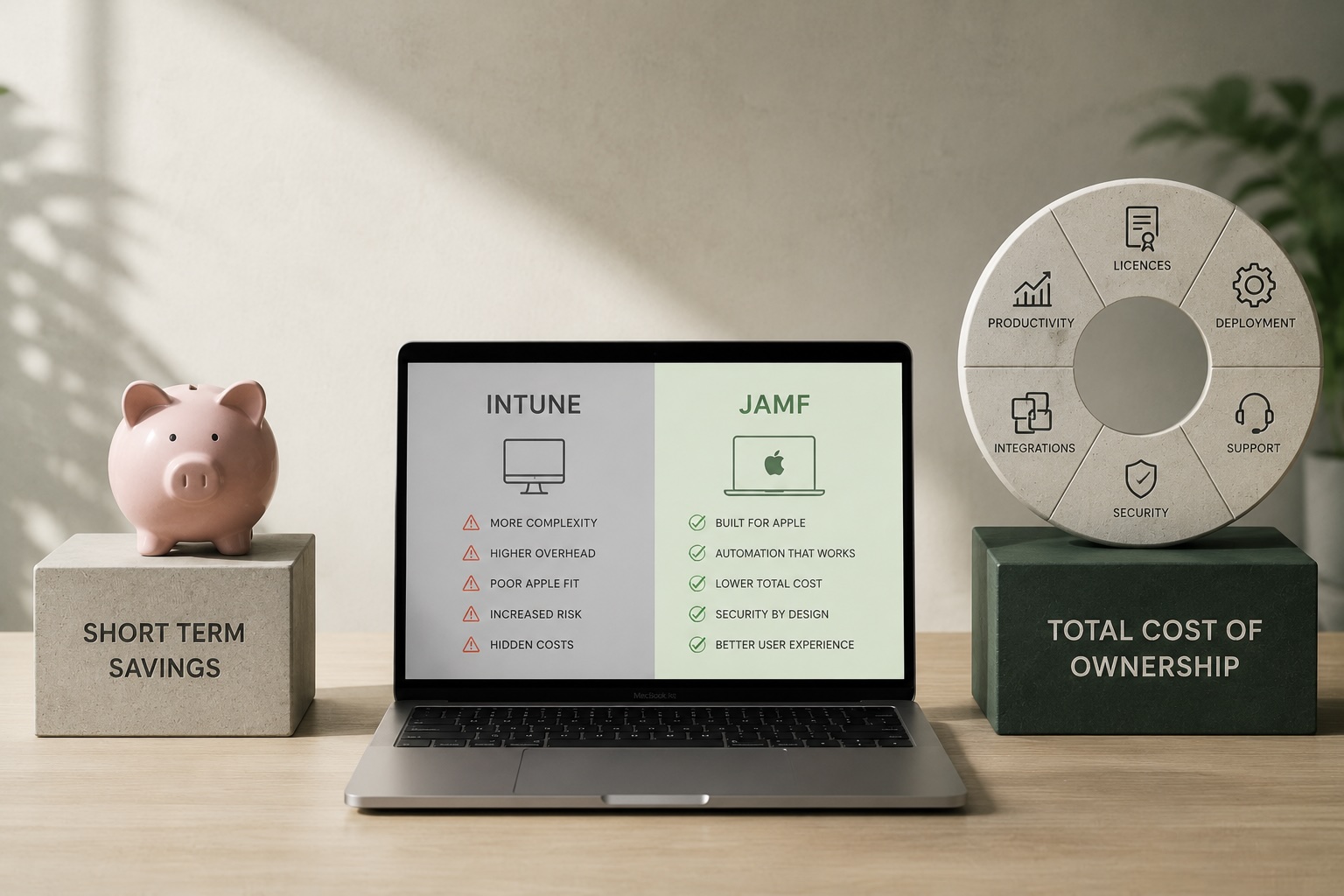
“Drop Jamf, move everything to Intune, cut a line item.” It sounds like a saving. Measure it properly, on total cost of ownership rather than licence price, and three things become clear: it is not cheaper, it is markedly more work, and Intune is not the tool Apple was built for.
TL;DR
- R154 per user per month is Intune’s own list price. You already prepay it inside every E3 and E5 seat, used or not.
- R0 of your Microsoft bill comes back when you drop Jamf. Intune was never a separate line to remove.
- Minus R530,000 a year is the total-cost result of consolidating a 500-Mac estate onto Intune, before a single incident.
The pitch usually arrives at renewal, and it is a good one: “We already pay for Intune inside Microsoft 365. Drop Jamf, consolidate onto one platform, one bill, and save the money.”
It is being made to Apple-running businesses across South Africa right now, and on the surface it is hard to argue with. The flaw is in the comparison itself. It sets one licence fee against another and stops there, and that is not how you cost a change to the way your business runs. The honest measure is total cost of ownership: every rand the decision touches over its useful life, including the work it creates and the risk it carries. On that measure the pitch fails on three fronts, and each one is worse than the last.
One. It is not cheaper
Start with the licence, because that is the only number the pitch actually counts, and it is the smallest one in the equation.
Intune is not free. It is prepaid. Buy it on its own through the local channel and Intune Plan 1 costs about R154 per user per month (First Technology NCE pricing, excluding VAT). You are already paying that inside every Microsoft 365 E3 and E5 seat you own, whether anyone has opened the Intune console or not. Dropping Jamf recovers none of it, because Intune was never a separate line on your bill. So the consolidation maths is not “Jamf plus Intune, minus Intune.” It is simply “minus Jamf.” Your Microsoft spend does not move a cent.
And that Microsoft spend is rising on its own. On 1 July nearly every enterprise plan took its first across-the-board increase since 2021, stacked on volume discounts Microsoft removed from Enterprise Agreements in late 2025, for a combined impact near 20% for many businesses. Meanwhile the bundle is mostly unused: independent utilisation research finds roughly half of E5 licences deliver no return, about 23% assigned to inactive users and another 27% never assigned at all. The newest tier, E7, adds nothing for device management, and Gartner’s advice is to treat it as negotiating leverage at renewal rather than an upgrade.
| Plan | Per user / month | What it adds for device management |
|---|---|---|
| Intune Plan 1 (standalone) | R154 | Sold on its own. This is the price already hiding inside your bundle. |
| Microsoft 365 E3 | R583 | Intune Plan 1 and 2, Defender for Endpoint P1, Entra ID P1 |
| Microsoft 365 E5 | R992 | Adds Defender XDR, Entra ID P2, Purview premium compliance |
| Microsoft 365 E7 | new tier | Adds Copilot and Entra Suite. No new device management. |
So the claim that Jamf is the expensive line is upside down before we even count the work. Now count it. When you retire Jamf you do not retire the job Jamf was doing. That job moves off one predictable invoice and reappears across your payroll, two or three other vendors, and a monthly fee from your hardware partner. Add it all up and the picture inverts.
| Line | Per year |
|---|---|
| Jamf for Mac licence removed (apparent saving, R225/device/mo) | +R1,350,000 |
| Intune cost recovered by dropping Jamf | R0 |
| Added Mac operational work (~0.5 senior Apple admin FTE) | −R400,000 |
| Point tools beyond Microsoft, kept or added (third-party) | −R300,000 |
| Open-source tooling and script build plus maintenance (~0.25 FTE) | −R220,000 |
| Hardware partner Apple practice fee (~R80,000/month average) | −R960,000 |
| Net “saving” | −R530,000 |
Minus R530,000 a year. You remove one predictable R1.35 million line and take on roughly R1.88 million of scattered cost in its place. That is the number the licence comparison never shows you, and it is before you price one security incident, one POPIA finding, or the productivity drag of a slower, patchier Mac experience. The practice fee alone consumes most of the apparent saving. Everything else pushes you underwater. Intune, meanwhile, still costs exactly what it cost before. That was never the line you could remove.
Two. It is far more work
The cost above is really a story about labour, so it is worth making the work itself explicit, because this is where consolidation hurts most and shows up least on a quote.
Jamf automates the things that keep an Apple estate healthy. Patching runs across roughly 700 Mac applications without anyone packaging them by hand. Devices configure themselves on first boot. Users self-serve their own software. Move that to Intune, whose deepest integrations are with Windows and Entra ID, and a large share of it becomes manual: packaging apps, writing and testing configuration profiles, chasing updates that no longer happen on their own.
What the platform cannot do gets held together with glue. First a layer of point tools that sit outside the Microsoft bundle, a Mac patch and app-deployment tool, a privilege-management tool, a Mac security layer, each a separate contract and renewal. Then a layer of open-source projects and in-house scripts, Installomator, Munki, Nudge, custom shell and Python. There is no licence fee on that layer, so it looks free. It is not. It is engineering time to build, ongoing time to maintain, and it is key-person risk the day the person who wrote it leaves and takes the only working knowledge of it with them.
Then comes the tell. Your hardware partner offers to plug the gaps for you, and in the South African market that Apple practice fee averages around R80,000 a month on top of the devices. Notice the incentive: the partner that wants to keep selling you Macs has every reason to keep you dependent, and turning the management gaps into a monthly retainer does exactly that. When even your device supplier is charging to cover what the platform cannot do, the gaps are not theoretical. You are paying for them either way.
The honest version of the pitch: “Consolidating to Intune removes the Jamf licence, adds manual Mac administration, keeps you paying for point tools and open-source glue to cover the gaps, and hands your hardware partner a practice fee to manage what is left.” Nobody sells it in those words, because said plainly it stops sounding like one platform and one bill, and starts sounding like three vendors, several renewals, and a heavier load on your own team.
Three. It is not the right tool for the job
Set the money aside for a moment, because even if the numbers were even, this would still be the wrong swap. Intune is an excellent product. It was built for Windows, and on Windows it is hard to beat. Apple, inside Intune, is a guest. It is managed through a platform designed for a different operating system, and that shows in the depth.
Give Microsoft its due: it has closed real ground on the Mac this year, with declarative device management for software updates, native support for the DMG app type, and a higher script size limit. But Jamf does only one thing, Apple, and it does it to the floorboards: same-day support for new macOS and iOS releases, native use of Apple Business and declarative management as first-class citizens, and an App Catalog that keeps hundreds of titles current without a script in sight. That is not a longer feature list. It is the difference between a platform that tolerates Apple and one that was built for it.
The gap matters most in security and compliance, where it stops being a preference and becomes exposure. Microsoft Defender’s strongest response actions, device isolation and containment, remain Windows-only, so your Mac incident response is thinner than your Windows response on the same console. And data loss prevention for non-Office files on macOS is a live gap until Microsoft Purview’s Mac file labelling reaches general availability on 30 September 2026, with advanced protection limited even then. For a POPIA-regulated business handling personal information on Macs, that is not a roadmap footnote. It is a hole in your controls with a date on it.
And there is the experience itself, the reason your team chose Apple in the first place. Devices ready on day one. Updates that happen in the background. Access that leaves the moment a person does. Security that protects without getting in the way. That experience is not a property of the hardware. It is what good management preserves, and it is exactly what erodes when Apple is run by a platform built for something else.
Decide on total cost, not licence price
Scaling Up treats cash as a discipline, not an outcome, and warns that the decisions that quietly drain it are the ones dressed up as savings. A consolidation that trims one visible licence while loading operational labour, tool sprawl, a monthly practice fee, and compliance risk is exactly that trap. The discipline is to price the whole thing, not the line that is easy to see.
Before anyone signs, pull the real data. What does an hour of manual Mac patching cost across a year, and who owns the scripts when their author leaves? What would your hardware partner’s practice fee total over the contract? What are you exposed to under POPIA if macOS data loss prevention has a gap until the fourth quarter? “It’s included” is not analysis. Total cost of ownership is, and it is what protects the cash.
Depth is the saving
Consolidation promises to simplify your bill. What it actually does is take complexity off one clean invoice and scatter it across your team, your vendors, and your risk register, while handing your Apple estate to a tool that was built for a different job. Cheaper on the licence line, more expensive everywhere else, and weaker where it counts.
Apple environments need a partner, not just a platform. Jamf is the enabling technology. Onsite brings the strategy, the implementation, and the operational maturity that turn it into an Apple setup that simply works, whether you run 25 Macs or 2,500. Across more than 400 organisations, in 33 countries, on over 100,000 managed devices, and 15 years spent on Apple and nothing else, the pattern holds: businesses that manage Apple with depth get more from it, for less total cost, than businesses that fold it into a platform built for something else. That is the whole argument. Depth over breadth.
Before you accept that switching saves money, let us build the total-cost model against your fleet, your quotes, and your compliance obligations. If the honest maths says Intune is right for you, we will tell you. If it says depth is the saving, you will have the number to prove it.